On this page
On 3 October 2026, CERRT.NG, the Computer Emergency Readiness and Response Team of the National Information Technology Development Agency (NITDA), told organisations and their staff not to put personal, classified or confidential information into public AI tools such as ChatGPT, Gemini, Claude and Copilot. In our reading, most of that advice is not new. It puts into practice duties the Nigeria Data Protection Act 2023 already places on businesses that handle personal data: use only the data a task needs, keep it secure, have written terms with anyone who processes it for you, and record your basis for sending it abroad. The Act also makes a business legally answerable ("vicariously liable") for its employees' acts that relate to its business.
Our view is that the bigger risk is not which AI tool your staff use but which account they use it on: a staff member's personal chatbot account comes with no agreement between the provider and your business. If you do one thing this week, write a short never-paste list (see What to do) and send it to your team.
What NITDA said
The advisory was posted on X and reported by Nairametrics and The Sun. It warned that information entered into public AI platforms "may no longer remain under the control of the organisation that provided it": the provider could retain it, log it or use it to train its models. Where personal data is involved, it said, this could be a personal data breach. NITDA advised using only approved AI tools; removing, anonymising or pseudonymising personal and sensitive information first (for example, replacing names with codes); reading each platform's privacy terms; and not uploading internal documents unless specifically authorised.
Legit.ng and Media Rights Agenda give the advisory's reference number, NITDA-0926-003, and report more of its content. In their accounts it also names Meta AI; lists what people commonly paste, such as National Identification Numbers (NIN), Bank Verification Numbers (BVN), bank details, medical results and family details; warns that AI answers can sound authoritative but be wrong; and asks organisations for an AI governance policy covering approved tools, permitted uses, data-handling rules and accountability. We could not confirm that this is the same document as the X post, and we could not open NITDA's original post or the advisory itself, so everything in this section, quotes included, is the reporters' wording, not NITDA's.
The law behind each tip
As reported, the advisory referred only to "applicable data protection laws" and did not name one. Each tip matches a duty in the Nigeria Data Protection Act 2023 (NDPA) or the 2025 General Application and Implementation Directive (GAID) from the Nigeria Data Protection Commission (NDPC), the regulator set up under the Act. Linking each tip to the law is our own reading, not legal advice:
Keep personal data out: the Act says personal data must be "limited to the minimum necessary" for the purpose (section 24(1)(c)). If a task works without the customer's name, leave the name out. Alexander Onwe, an Assistant Manager (Legal) at the NDPC, has also said you must establish a lawful basis before uploading another person's information into an AI system, and that consent may be needed depending on the circumstances. A lawful basis is one of the reasons the Act accepts for using personal data, such as the person's consent or a contract with them (section 25).
Swap names for codes: the Act lists this, which it calls pseudonymisation, among its security measures (section 39(2)(a)).
Use approved tools: when another company handles personal data for your business, you need a written agreement with it (section 29), and GAID Article 34 lists what the agreement must cover, including where the data is processed. A staff member's personal chatbot account comes with no such agreement with your business.
Read the terms: they tell you where your data goes. Personal data may leave Nigeria only if the recipient is bound to protect it adequately, by the law where it is, a contract or similar rules, or if another condition applies, such as the person's informed consent. You must write down which basis you rely on (sections 41 to 43). We think pasting into a tool hosted abroad likely counts as sending data abroad (see What is still unsettled).
Treat a slip as a possible breach: if a breach is likely to put people's rights at risk, tell the NDPC within 72 hours of finding out. If the risk is high, tell the people affected immediately. Keep a record of every breach (section 40).
Have a policy and train staff: the GAID asks for an internal policy and a basic privacy checklist for staff (Article 7(n)), training at least once a year (Article 7(v)) and periodic training on new developments (Article 46(3)).
What the advisory leaves out
The business answers for its staff. Section 53(2) makes a business "vicariously liable" for the acts or omissions of its employees "in so far as the acts or omissions relate to its business". In practice, in our reading, if a staff member pastes customer data into a chatbot for a work task, the business carries the legal risk. Section 48 caps the penalty or remedial fee the NDPC can impose at the higher of N10 million or 2% of the previous financial year's annual gross revenue for organisations "of major importance" (see the next point), and the higher of N2 million or 2% for others. The NDPC can also order the business to compensate people harmed and to account for any profit made from the violation, and people harmed can sue for damages (section 51).
"Major importance" starts low. GAID Schedule 7 treats as "of major importance" any organisation that keeps a filing system of personal data, on paper or digital, and either processes the personal data of more than 200 people in six months or works in a listed sector, such as finance, insurance, health, education, communication, e-commerce, hospitality and tourism. It says some are not of major importance, including traders with fewer than 15 employees, and artisans, who keep no specific filing system of customer data beyond routine phone contacts, receipts, addresses and email addresses. It also exempts some bodies, such as faith-based organisations and community-based associations, from registering. In our reading, if your business keeps records of more than 200 customers, staff or suppliers from the last six months, on paper or on a computer, it is likely covered unless one of those exclusions plainly fits. Those designated must register with the NDPC, listing among other things the countries their data goes to (section 44), and name a Data Protection Officer, a person who advises the business and its staff on the Act and monitors compliance (section 32).
BVN and NIN are not "sensitive" data under the Act, but leaking them can still be high risk. The Act's sensitive list covers categories such as health, biometrics and religion, not ID numbers, and we found no NDPC directive adding them (it can, under section 30(2)). But GAID Article 33(2) treats a breach as likely high risk where the person may become a victim of fraud or identity theft. In our reading, a leaked BVN could meet that test, which means telling the customer immediately.
What the AI providers' terms say
We checked the published terms for the four tools that every report we saw names: ChatGPT, Gemini, Claude and Copilot. Our finding: the type of account matters more than the brand. Legit.ng and Media Rights Agenda say the advisory also names Meta AI. We did not review Meta AI's terms for this post, so treat it like any personal account: no customer or staff data.
Two terms you will see in business plans: a processor handles personal data on your behalf, which is the relationship section 29 expects, and a data processing (or data protection) addendum is the written agreement that sets it up.
Personal accounts are an agreement between your staff member and the provider, not your business. What happens to the chats depends on the tool:
Gemini: Keep Activity is on by default for users aged 18 and over, so chats can be used to train models. Some are read by human reviewers and kept for up to three years.
Claude (Free, Pro and Max): chats are used for training only if the user allows it, under Settings, Privacy, and may then be kept, de-identified, for up to five years.
Copilot (Microsoft's app for individuals): Microsoft says prompts are not used to train foundation models.
ChatGPT: we could not open OpenAI's consumer help pages to confirm the defaults.
Whichever tool it is, before any work use of a personal account, open the tool's data or privacy settings and check whether chats are used for training.
Work accounts (paid business plans) come with written terms between the provider and your business:
ChatGPT Business, Enterprise and Edu: data is not used for training by default.
Claude's commercial plans: not trained on by default, with a data processing addendum built into the terms. On Team and Enterprise, Anthropic acts as your processor.
Gemini in Google Workspace: Google treats prompts as customer data under its Cloud Data Processing Addendum, and says they are not used to train AI models outside your organisation's domain without your permission.
Copilot on a work account: covered by Microsoft's Data Protection Addendum, with Microsoft as processor.
Watch for these as well:
Free developer tools are not work accounts. If anyone on your team uses the free Gemini API or Google AI Studio (Google's developer tools), Google's terms say human reviewers may read what is submitted, and tell users not to submit personal information. Users in the European Economic Area, Switzerland and the UK get the paid-tier data terms even on the free tier; users in Nigeria do not. AI Studio counts as paid, even at no charge, if the account has access to a Cloud project with active billing or is a Workspace enterprise account, and the API counts as paid only through a Cloud project with active billing. On paid terms, Google says it does not use prompts or responses to improve its products, so if your developers use these tools, link billing first.
Expect your data to leave Nigeria. None of the documentation we read offers processing in Africa. OpenAI's API offers in-region processing only in the US, Europe and the UAE. Anthropic stores data in the US and may route traffic to the US, Europe, Asia and Australia. Microsoft says customers outside the EU may have Copilot queries processed "in the US, EU, or other regions". In our reading, that brings in the cross-border rules in sections 41 to 43.
Deleting is not a guarantee. In 2025 a US court made OpenAI keep ChatGPT logs, including chats that would otherwise have been deleted, for the New York Times' copyright case. The judge ended that duty for new data in October 2025, but logs already saved under the earlier order were kept, and OpenAI still had to preserve data from accounts the New York Times flagged.
We think "not used for training" answers only one of the law's questions. A work account gives you a written agreement to start from, but you still need a recorded basis for sending data abroad. Compare the provider's agreement with the list in GAID Article 34 and take the gaps to a Nigerian data protection lawyer.
Staff have already leaked data this way abroad
We found no documented Nigerian case, but regulators abroad have. The Dutch data protection authority said in August 2024 that it had received several breach notifications after staff put personal data into AI chatbots: a GP practice employee entered patients' medical data, and a telecom company employee entered a file including customer addresses. It said that when staff do this against their employer's rules it is a data breach, and that where the organisation's own policy allows it, it is not a breach but is often not legally permitted either.
In Australia, a former temporary staff member at the NSW Reconstruction Authority uploaded data from an Excel spreadsheet to ChatGPT, a tool the authority had not authorised, between 12 and 15 March 2025. The data, which affected 2,031 people in its Northern Rivers Resilient Homes Program, included names, addresses, dates of birth and health information. The authority then put controls in place to block uploads of personal information into AI tools.
The lesson we take: staff already use these tools, and a rule on paper is not enough without training and technical controls, such as the upload block the NSW authority added afterwards.
What to do
This week
Ask what people already use: which tools, on which accounts, for which tasks. We suggest saying up front that no one will be disciplined for past use, since otherwise you may not get honest answers. In a larger team, use an anonymous form.
Write a one-page AI use policy covering the four points the advisory reportedly lists: approved tools (on work accounts), permitted uses, data-handling rules and who is accountable. If you have a company account, a line could read: "Approved: [tool] on the company account, for drafting emails, summaries and first drafts. Not approved: personal accounts for any work task." Add a never-paste list: NIN, BVN, account and card numbers, medical details, salaries, customer lists, contracts and anything marked confidential. In our view, if paid work accounts are not in your budget yet, the answer is a stricter rule, not no rule. No personal or confidential data goes into any AI tool, and staff work only on made-up examples (see below).
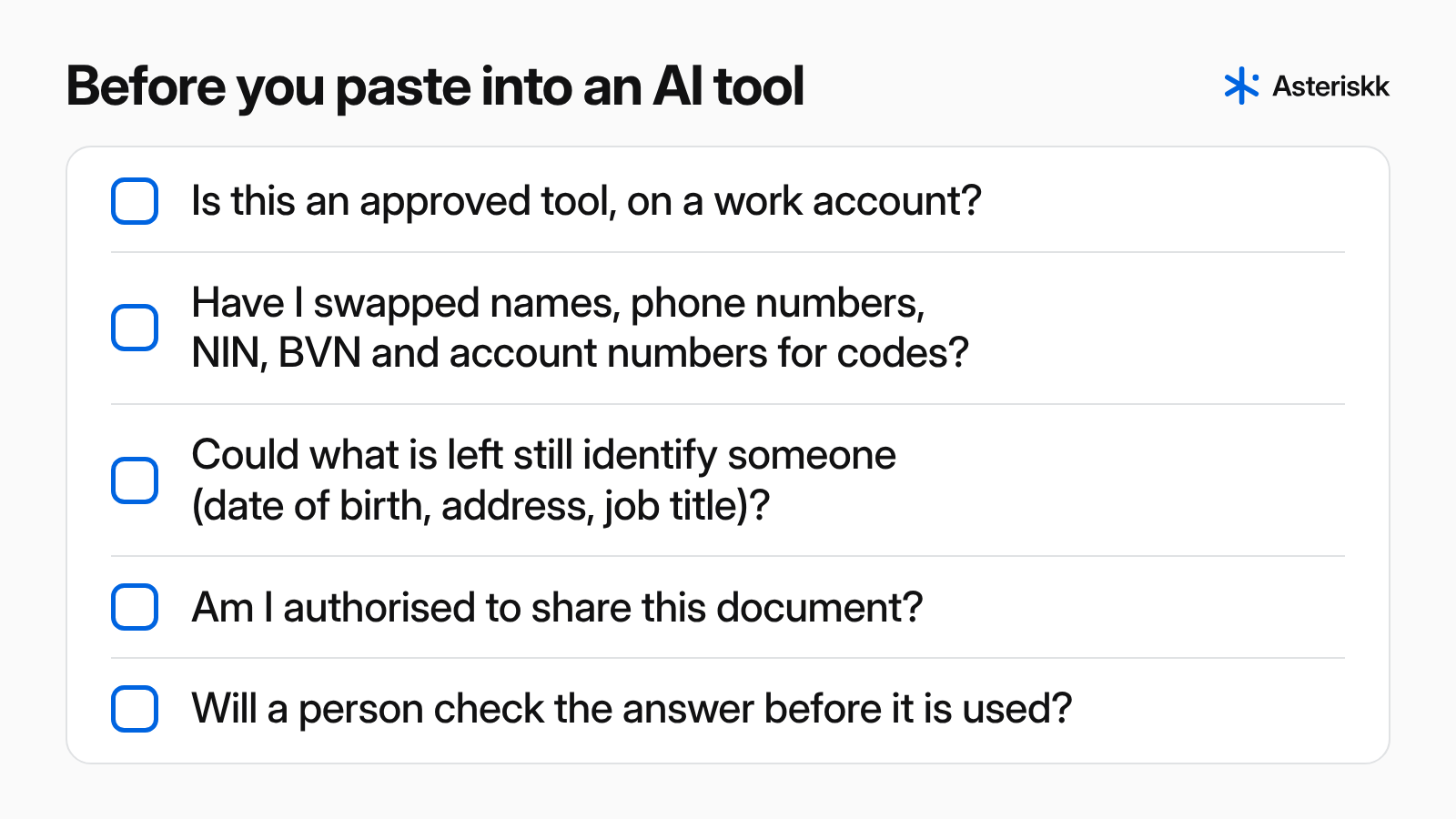
Teach one way to strip personal data (below). Print the Before you paste checklist and pin it up, and post it in your team's group chat.
Decide who checks AI answers before anyone acts on them: normally the person who would sign off that work if a colleague had written it. Make this a firm rule for anything about health, law or money.
How to strip personal data before you paste
Swap names, phone numbers, NINs, BVNs and account numbers for codes. Make the codes up (CUSTOMER_001, CUSTOMER_002 and so on), and keep the list linking codes to people in your own systems, never in the AI tool. The Act's own definition of pseudonymisation assumes that list is kept separately and secured. EU regulators also stress that pseudonymised data is still personal data, so this lowers the risk without removing it.
Do not create the codes by running names through a formula such as a hash: EU regulators' draft guidelines warn that anyone who already has the names can run the same formula and match them.
Blur details that could identify someone when combined: an age band instead of a date of birth, a state or Local Government Area instead of a street address, "a manager" instead of an unusual job title.
Better still, give the AI a made-up example with the same shape. Instead of pasting a real customer's complaint, write "A customer says a transfer failed twice and she was charged both times" and ask for a reply template.
Software that finds and removes personal data automatically helps, but it misses things: Presidio, one such tool, says in its documentation that it cannot guarantee it will find all sensitive information. Have a person read the text before it is pasted.
This month
Move work use onto work accounts. Download and file the provider's data processing agreement and check that it says, at least, what the data is used for, where it is processed, what security measures apply and how confidentiality is kept. GAID Article 34 has the full list of 20 items. Ask a lawyer which basis for sending data abroad fits your case, then write it down. If paid work accounts are not in your budget yet, keep to the stricter rule above: no personal or confidential data in any AI tool.
In the admin settings of your business plan, look for three controls: how long chats are kept (choose the shortest period that works for you), a log of who used the tool, and any option to block file uploads. Not every plan has all three.
Check whether you need a Data Privacy Impact Assessment (DPIA), a written review of the risks a type of processing poses to people's privacy. GAID Article 28(3) makes one mandatory, filed with the NDPC, in a list of cases that includes cross-border transfers, new technology that may pose a significant privacy risk, and digital financial services, health care, e-commerce, education and hospitality. It must be done before the processing starts, and vetted and signed by a Data Protection Officer accredited by the NDPC (Article 28(4), (9) and (12)). In our reading, if pasting personal data into a tool hosted abroad counts as a cross-border transfer (see What is still unsettled), using AI on customer data would need one. That is one more reason to keep personal data out of these tools. If you may be of major importance, also confirm your registration and your Data Protection Officer.
Train everyone at least once a year, as GAID Article 7(v) expects, and again whenever you approve a new tool. We suggest a short session: go through the never-paste list and the checklist using two or three examples from your own work.
Plan for a slip
Make it easy and blame-free to report a mistake at once: the 72-hour clock runs from when the business becomes aware.
Write down what was pasted and whether names had been swapped for codes. When judging how serious the risk is, the Act lets you take de-identification into account (section 40(7)).
Log every incident, even if you decide not to notify.
Delete the chat, but do not count on that to undo the exposure.
Get legal advice the same day on whether to notify the NDPC and the people affected.
What is still unsettled
Nothing we found from NITDA or the NDPC settles these questions:
Whether one paste of personal data triggers the 72-hour notice. As reported, NITDA said only that it "could" be a breach.
Whether an AI provider is your processor (handling data for you under your agreement) or a controller in its own right (deciding for itself how it uses the data). In our reading, the answer decides which of the Act's rules apply to your arrangement with the provider.
Whether pasting personal data into a tool hosted abroad is a cross-border transfer. Our reading of section 41 is that it likely is.
Whether staff use of a chatbot counts as "deploying" AI to process personal data under GAID Article 43. If it does, that Article expects the business to document its safeguards, file them with the NDPC as part of its compliance audit returns, and carry out a DPIA.
The NDPC plans to review the Act for AI, and the National Assembly began its own review in May 2026, citing the rise of AI, but we found no published draft of AI-related changes from either. This is not legal advice: see a data protection lawyer if you handle financial or health data, may be of major importance, have had a slip, or are building AI into a product.
The bottom line
NITDA's warning is not a ban on AI at work. Our view: most of the risk sits in personal accounts and in real customer details, and both can be dealt with this week. Start by sending your team the never-paste list.
Asteriskk builds AI assistants, predictive models and data pipelines into the workflows a business already runs. Read about our AI and data work, or get in touch.
Sources
Nairametrics, NITDA warns organisations, staff against sharing sensitive data with public AI tools, 4 October 2026
The Sun, NITDA warns workers against feeding sensitive data into public AI tools, 4 October 2026
Legit.ng, NITDA Issues Warning to Nigerians Using ChatGPT, Gemini, Meta AI, Gives 5 Safety Tips, 5 October 2026
Media Rights Agenda, NITDA Warns Nigerians Against Sharing Sensitive Personal Information on AI Platforms, 6 October 2026
Nigeria Data Protection Commission, Nigeria Data Protection Act, 2023 (PDF), 2023
Nigeria Data Protection Commission, NDP Act General Application and Implementation Directive (GAID) 2025 (PDF), 20 March 2025
Voice of Nigeria, NDPC Urges Responsible AI Use, Data Protection, 25 October 2026
Google, Manage and delete your activity in Gemini Apps, viewed 7 November 2026
Google, Gemini Apps Privacy Hub, updated 26 October 2026
Anthropic, How do I change my model improvement privacy settings?, 3 August 2026
Anthropic, How long do you store my data?, 1 July 2026
Microsoft Support, Microsoft Copilot for individuals: your activity history, 18 August 2026
OpenAI, ChatGPT Work cloud security, viewed 7 November 2026
Anthropic, Is my data used for model training? (commercial products), 18 August 2026
Anthropic, How do I view and sign your Data Processing Addendum (DPA)?, 16 March 2026
Anthropic, Does Anthropic Act as a Data Processor or Controller?, updated 30 October 2026
Google Workspace, Generative AI in Google Workspace Privacy Hub, updated 6 October 2026
Microsoft Learn, Enterprise data protection in Microsoft Copilot and Microsoft Copilot Chat, 29 May 2026
Google, Gemini API Additional Terms of Service, effective 23 March 2026
OpenAI, Data controls in the OpenAI platform, viewed 7 November 2026
Anthropic, Where are your servers located? Do you host your models on EU servers?, 15 June 2026
Microsoft Learn, Data, Privacy, and Security for Microsoft Copilot, 9 July 2026
Engadget, OpenAI no longer has to preserve all of its ChatGPT data, with some exceptions, 11 October 2025
Autoriteit Persoonsgegevens (Dutch Data Protection Authority), Let op: gebruik AI-chatbot kan leiden tot datalekken (in Dutch), 6 August 2024
NSW Government, Resilient Homes Program data breach, 5 October 2025, last updated 26 March 2026
European Data Protection Board, Pseudonymisation: when and how to apply it (PDF summary), February 2025
European Data Protection Board, Guidelines 01/2025 on Pseudonymisation (PDF, version for public consultation), 16 January 2025
NIST, SP 800-188, De-Identifying Government Datasets: Techniques and Governance, September 2023
Presidio, Presidio documentation, viewed 7 November 2026
News Agency of Nigeria, NDPC Mulls Data Protection Act Review For AI, Emerging Technologies, 21 June 2026
National Assembly Library Trust Fund, National Assembly Initiates Review of National Data Protection Act, 14 May 2026
- Data protection
- NITDA
- NDPA
- AI policy
- Nigeria
- Generative AI